FIREWALL MIGRATION
Firewall Migration Manager
COMPANY
Cisco (NetSec)
ROLE
Lead UX Designer
PLATFORM
Web Platform
YEAR
2026
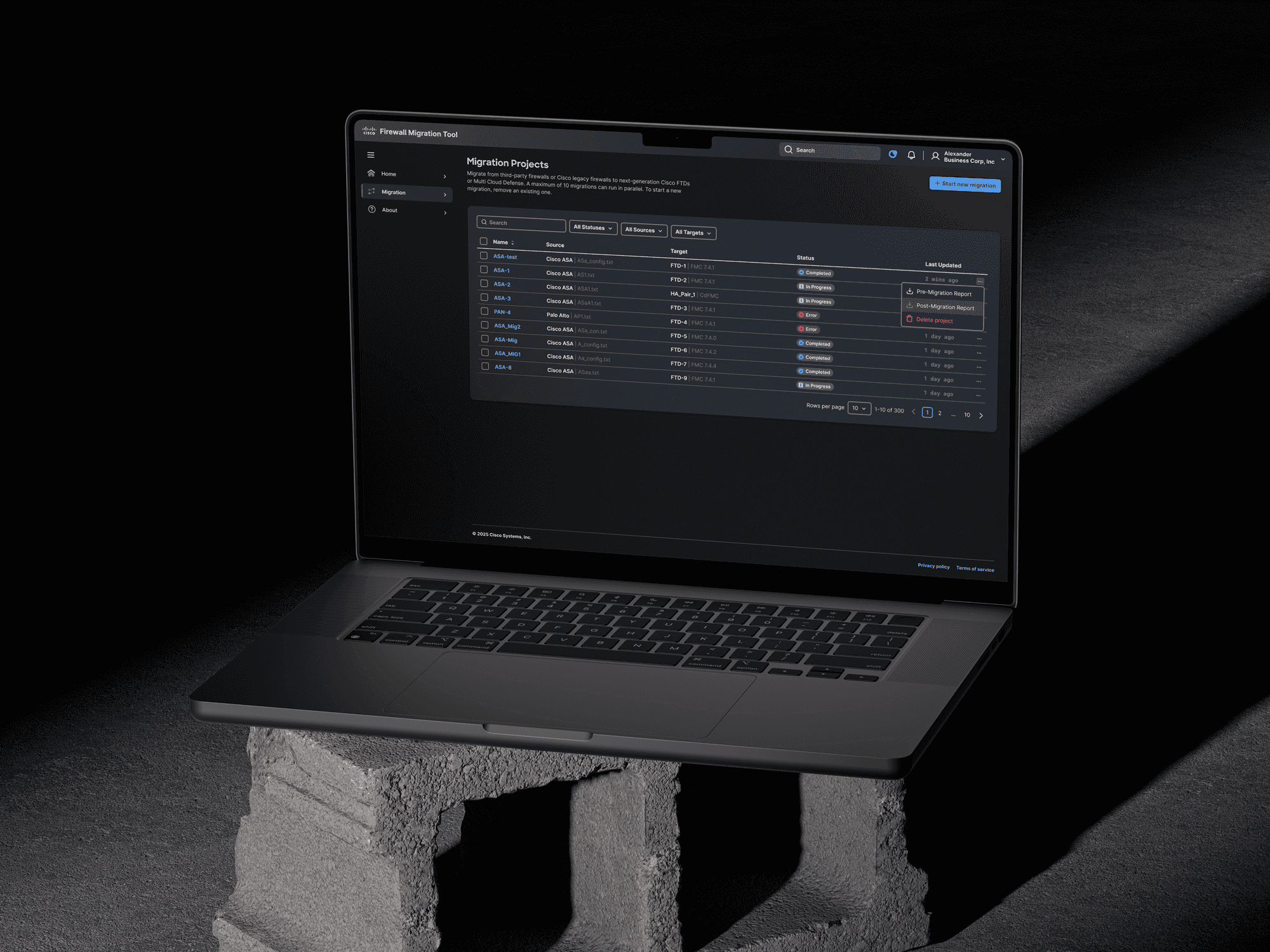
My Role
Firewall Migration Manager(FMM) was a complex enterprise cybersecurity workflow where users had to understand technical configuration, mappings, errors and migration outcomes. My role was to simplify that complexity without hiding the technical depth.
My responsibilities included
Understanding user needs and migration workflows.
Redesigning end-to-end migration journeys and information architecture.
Simplifying validation, mapping, optimization, and reporting experiences.
Designing AI-assisted workflows with human oversight.
Collaborating with cross-functional teams to deliver scalable, implementation-ready solutions.
Understanding Users
To build a solution that truly addresses the complexities of firewall migrations, we started by deeply understanding the core user—the Firewall Migration Manager (FMM) / Network Security Engineer.
Migrating network policies across multi-vendor environments is high-stakes, time-sensitive, and inherently risky. By mapping out our primary persona, we aligned our design choices directly with the engineer's daily workflows, anxieties, and core efficiency needs.
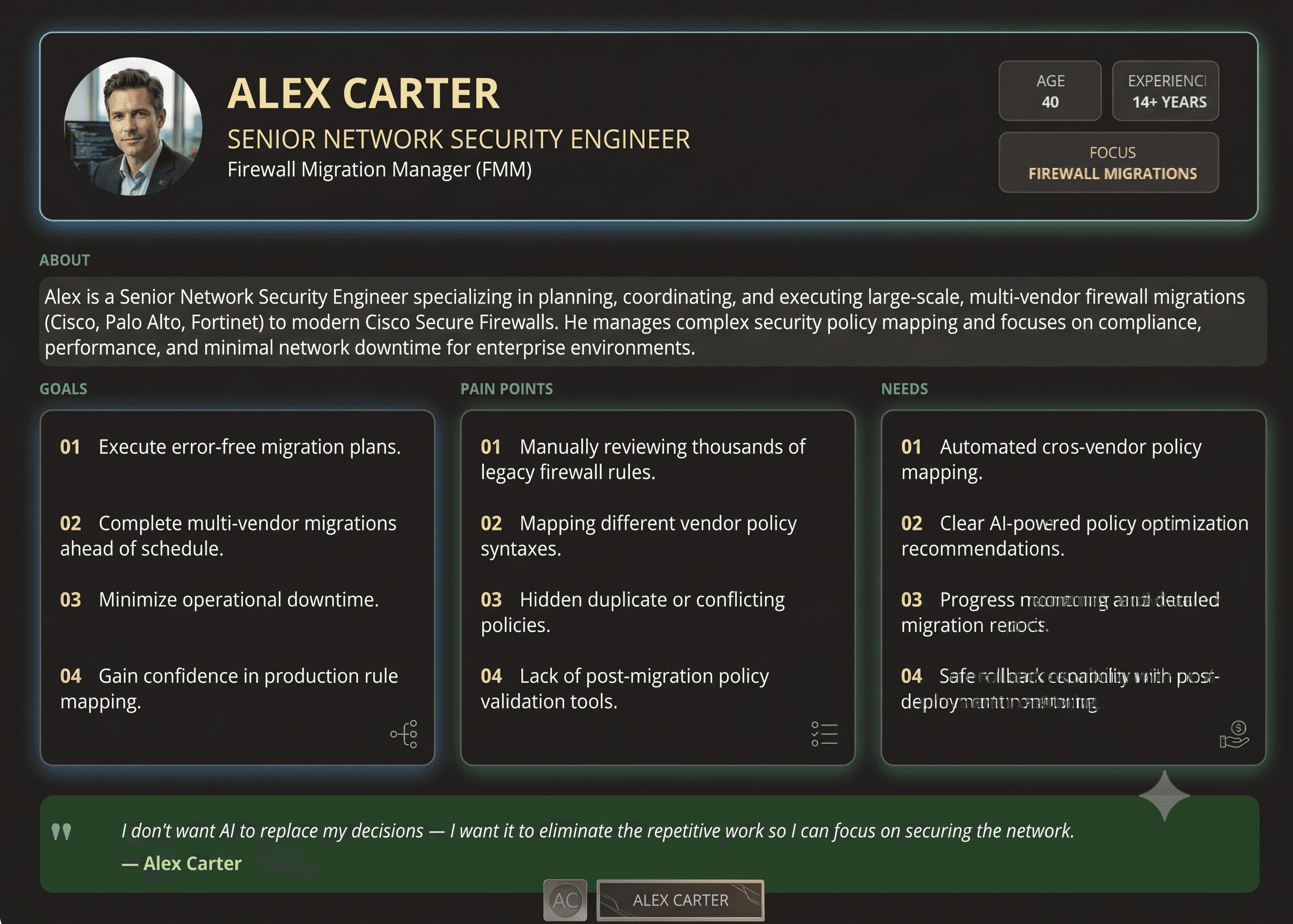
Core User Mindset & Principles
High Risk Aversion: Enterprise engineers prioritize network stability above all else. Automated features must never act like a "black box"—every AI recommendation needs clear reasoning and human sign-off.
Cognitive Fatigue: Scanning through 10,000+ firewall rules manually leads to error-prone deployments. The interface must reduce noise and bring critical policy conflicts to the surface instantly.
Operational Control: Engineers don't want autonomous execution; they want high-powered acceleration paired with granular monitoring and safe rollback capability.
Design Process
My design process for Firewall Migration Manager (FMM) focused on simplifying a technically complex migration workflow into a guided, intuitive experience. While the platform already existed, the challenge was to reduce manual effort, improve usability, and increase confidence throughout the migration journey.
I began by understanding the existing migration workflow, collaborating with product managers, engineers, and domain experts to identify user pain points, technical constraints, and opportunities for improvement. From there, I mapped end-to-end user journeys, streamlined information architecture, and redesigned key workflows to make the experience more efficient and transparent.
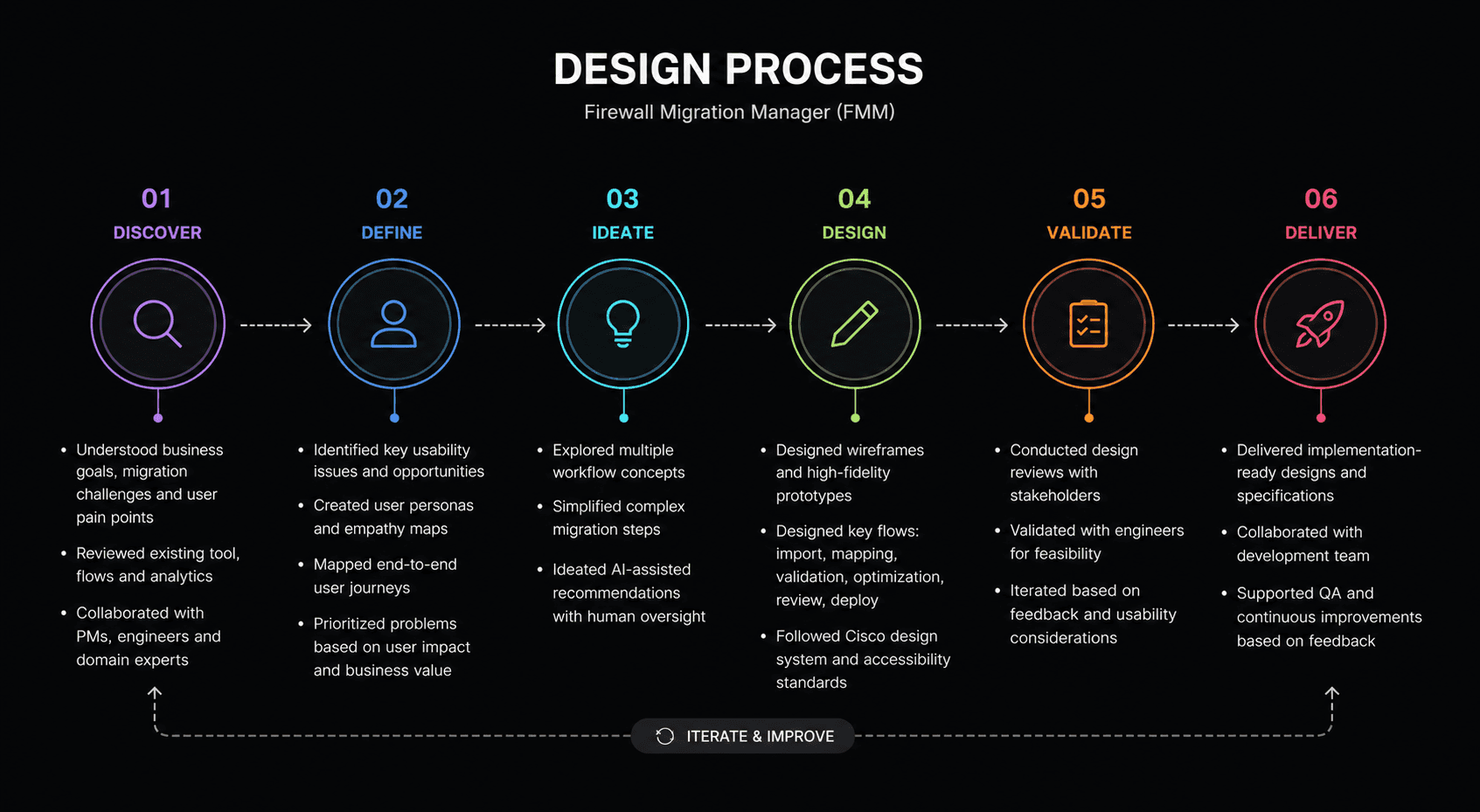
The design process focused on the core stages of the migration lifecycle:
Mapping interfaces, objects, and security policies
Importing and validating legacy firewall configurations
Identifying and resolving migration exceptions
Optimizing duplicate, unused, and conflicting rules
Reviewing migration reports and validating readiness
Deploying with confidence through monitoring and rollback support
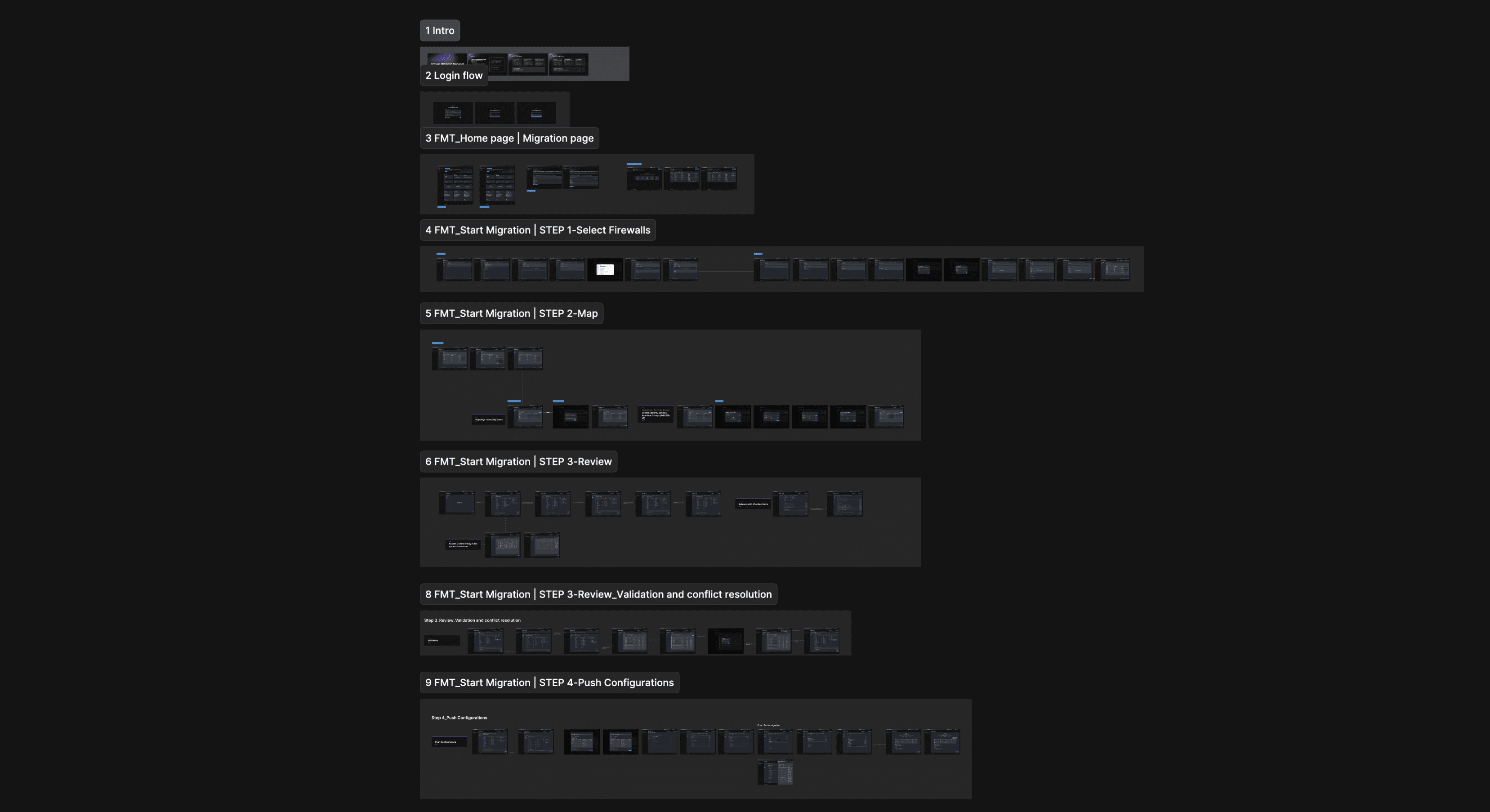
Outcome
The redesigned Firewall Migration Manager transformed a complex, manual migration process into a guided, AI-assisted experience. By simplifying key workflows, improving validation and policy mapping, and introducing intelligent recommendations, the solution reduced manual effort, increased deployment confidence, and provided greater transparency throughout the migration lifecycle.
Key outcomes:
Reduced complexity through guided, step-by-step workflows.
Improved accuracy with streamlined validation and policy mapping.
Increased user confidence with AI-assisted recommendations and human oversight.
Enhanced visibility through comprehensive reporting, monitoring, and rollback support.
Delivered a scalable, enterprise-ready experience aligned with Cisco's design system.